Nature's First Aid
The Natural First Aid Kit
Maya Dakdouk
June 2026
Share


As a mother of active boys who play soccer and other high-impact sports, and as someone living an active lifestyle myself, I have found Symphytum officinale (comfrey) and Arnica montana (arnica) to be essential first-aid remedies.
While both are powerhouses for healing, they serve very different roles in the recovery process. For example, imagine a soccer player taking a hard kick directly to the shin, or falling while running and twisted their ankle, in a high impact scenario like this understanding how to target the damage effectively depends on knowing who to call: your surface specialist, your structural specialist or both.
This article focuses on the topical application of these herbs in cream, ointment, poultice, or salve form.
Arnica montana: The Surface Specialist and First Responder.
Actions: anti-inflammatory, antimicrobial, astringent, analgesic.
Arnica is a popular homeopathic remedy, and it is a member of the daisy family which is one of the largest plant families in the world. Arnica shares this family with chamomile, calendula and echinacea, you can easily see the resemblance when you look at arnica bright yellow daisy-like flower heads. I have always considered arnica as my "surface specialist" for muscular or soft tissue damage, it is a master shock remedy ideal for immediate application after a collision or fall.
How it works: Arnica works on the fluid and blood trapped in traumatised tissues. Its primary active compound, a sesquiterpene lactone called helenalin, provides potent anti-inflammatory effects by selectively inhibiting the NF-Κb (nuclear factor kappa B) pathway, a major molecular trigger for swelling and pain. By clearing pooling fluids, it reduces the severity of bruising and eases initial tissue shock.
Which explains its traditional use for bumps, bruises, sprains and muscle pain.
Topical arnica cream is widely available over the counter. When purchasing, choose a high-quality, organic formula and follow package directions. Standard application typically involves gently massaging a thin layer into the affected area three to four times a day.
Did you know? Arnica stems from the Greek word arnaikis, meaning lamb’s skin a gentle nod to its soft, fuzzy leaves and its soothing nature.
Symphytum officinale: The Structural Specialist
Actions: anti-inflammatory, anti-oxidant, astringent.
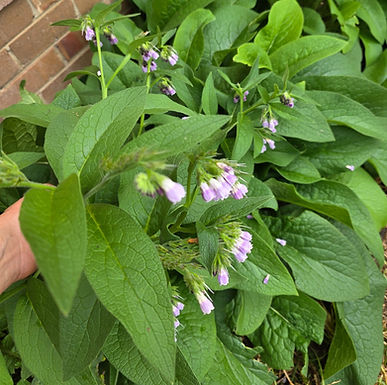
Comfrey has been cultivated as a healing herb since about 400 B.C.. It is a member of the borage family and members of this family are famous for having rough, bristly, or intensely hairy leaves and stems, which perfectly describes the scratchy texture of a comfrey plant. In my household, I view comfrey as my “structural specialist” for bone and deep tissue recovery. Especially fractures, severe sprains, sore joints, and tendonitis.
How it works: Comfrey contains allantoin, a compound that stimulates cell proliferation, effectively speeding up the body's ability to repair deep connective tissues and bones. Simultaneously, its rich concentration of rosmarinic acid delivers potent anti-inflammatory support which is needed to calm deep seated swelling.
Comfrey stimulates cell growth exceptionally fast, therefore it is best to reserve it for when the skin is clean and initial risk of surface infection has passed. Never apply it on a deep or open wound, or areas that require stitches. Doing so can cause the surface skin to close and trap harmful bacteria and active infections inside.
You can easily find Comfrey over the counter in ointment, salve or cream forms. It is also incredibly simple to craft at home using the leaves and roots infused in a high-quality olive oil and thickened with beeswax. Personally, I prefer using ointment because it adheres to the skin longer creating a protective barrier and allowing a sustained absorption of the herb. When purchasing comfrey, choose a high-quality, organic formula and follow package directions. Standard application typically involves gently massaging a layer into the affected area three to four times a day. If you have access to a fresh plant, you can easily make a fresh comfrey poultice at home. Simply crush the fresh leaves to release their healing juices, apply it to the affected area and secure it with a clean bandage or wrap. Repeat this process 2-3 times a day.
Did you know? Comfrey, often called “knitbone,” Its botanical name, Symphytum officinale, means “to unite or knit together.
Safety of Arnica and Comfrey:
For external use only. Do not ingest, and do not apply to open wounds, broken skin, or deep cuts.
Avoid Arnica if you have a known sensitivity to plants in the Arteraceae (Daisy) family.
Ensure the product is completely rubbed into a child’s skin to prevent accidental licking or ingestion.
Consult a healthcare provider before use if you are pregnant or lactating.
Due to the cumulative nature of comfrey’s active compound, avoid continuous topical application for more than 6 weeks per year.
To handle the injuries mentioned earlier, make sure the skin is completely unbroken, with no open cuts.
For the hard shin kick: Put Arnica on immediately to stop bruising, reduce swelling, and calm the surface tissue. A day after, apply comfrey to help heal the underlying bone that took the brunt of the hit.
For the twisted ankle: follow the exact same protocol. Use Arnica first to manage the immediate swelling around the joint and follow up with comfrey to support deep ligaments.
Ensure you seek medical attention.
This information is for educational purposes. Please consult with a healthcare professional before utilising herbal protocols, particularly if you are pregnant, nursing or managing pre-existing medical conditions.
On a final note, I discovered another wonderful use of comfrey plants completely by accident. My chickens happened to forage their way into my comfrey patch one day and began happily pecking away. Since then, I have started offering comfrey leaves to them occasionally as a moderate treat. They absolutely love it. Comfrey leaves are highly regarded for their dense nutrient profile, which is thought to support healthy growth, better egg production, and strong eggshells. I also add the leaves to my compost bin which is a wonderful traditional way to help naturally enrich and strengthen the garden soil.